

Our initial focus when exploring the border between Melilla and Morocco was the hard border defenses. The Melilla border fence forms part of the Morocco–Spain border in the city of Melilla, one of two Spanish cities in north Africa. Constructed by Spain, its stated purpose is to stop illegal immigration and smuggling. Melilla’s border and its equivalent in Ceuta, also bordering Morocco, are the only two land borders between the European Union and an African country

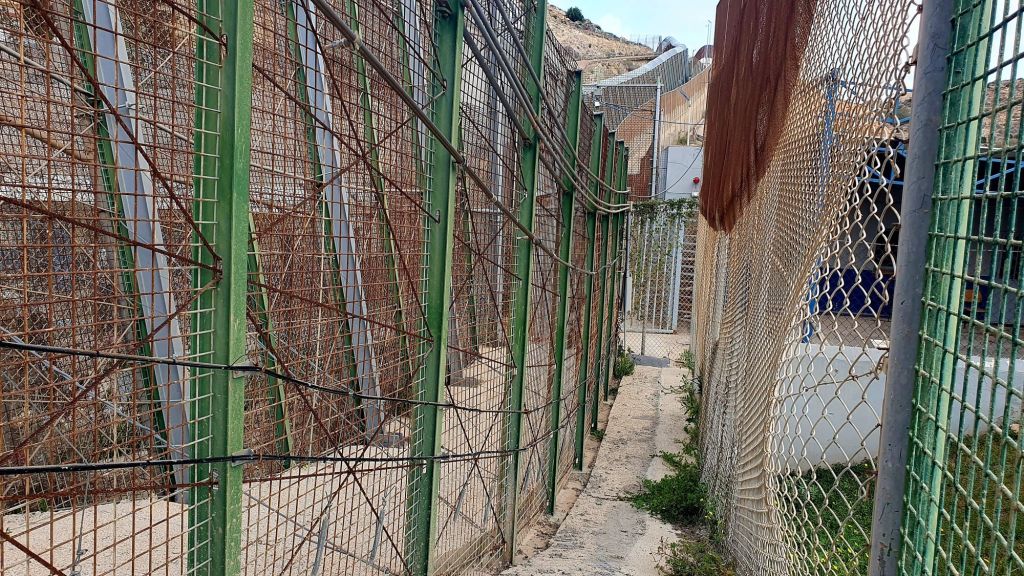
The barrier between Spain and Morocco, consists of a triple Spanish fence. The fence is approximately 11 km long. The triple fence was doubled in height in 2005 to 6m. It has watch towers, access roads, and a range of surveillance equipment. On the Moroccan side of the border, there are a further 2 fences, set back from the border and earthworks and ditches to prevent access. The Spanish side have mobile patrols whereas the Moroccan side have fixed observation points.
This border-fence structure is located on Spanish territory and its supervision, including the operation of its gates, remains under the exclusive control of Spanish authorities at all times. Spain acknowledges that its territory includes the border-fence structure. The EU, Spain, and Morocco cooperate closely on border control, a partnership that grants political and economic favors to Morocco for assisting the EU with the protection of its borders from irregular entry. Through this partnership, the EU delegates the responsibility for third-country nationals in search of protection to countries at its external borders to Morocco.
Prior to arriving in Melilla we had identified 2 border crossings however when we travelled along the length of the border, we identified 2 further border crossings. Border crossings are sensitive areas. At 2 of the four crossings we were challenged by law enforcement officials, on both sides of the border. It was at this crossing point that we experienced the most scrutiny with ordinary residents contacting law enforcement on both sides of the border to inform them of our presence. This led to questioning, checking of passports and requesting we delete any photos taken. This was not surprising given this areas recent history. We visited these points as part of the IBRG MOMEX-24 expedition.
The Melilla – Barrio Chino border crossing is located in the south west of the exclave, very close to the southernmost point. There are 4 crossing points between Melilla and Morocco. Only the one at Beni Ansar is open however. The other crossings were closed due to COVID and have not reopened. Originally this crossing point was used by locals, traders and school children. Local citizens of Nador can enter Melilla, although this entitlement has been subject to increased restrictions. It is important to note that although the autonomous cities of Ceuta and Melilla are officially considered part of the Schengen Area there are a few unique rules regarding travel to and from Ceuta and Melilla. These include document checks when departing from the cities when travelling to other parts of the Schengen Area. This means that technically, international travellers arriving in Ceuta or Melilla from a non-Schengen state have not yet arrived in the European free movement zone. As a UK passport holder I was checked prior to arriving and when leaving.
.


From the Spanish side
As we travelled down the Spanish side of the border we noticed another border crossing. At this stage we were unaware of the recent history at this point. As we observed the crossing 2 Guardia Civil vehicles arrived. We think that we were informed on by a young lad on a motorcycle.

The by now standard questions about why we were here, what were we doing, had we taken any photographs followed. Passports were checked and telephone calls were made. One officer spoke English and was friendly, the other less so. This was the closest to us being detained. In the end no further action was taken but it was a challenging moment.
Luckily for the purposes of this report, I was able to take and retain the following photos.
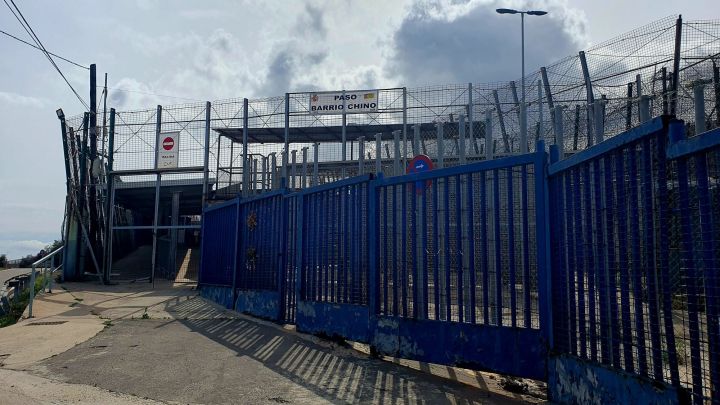
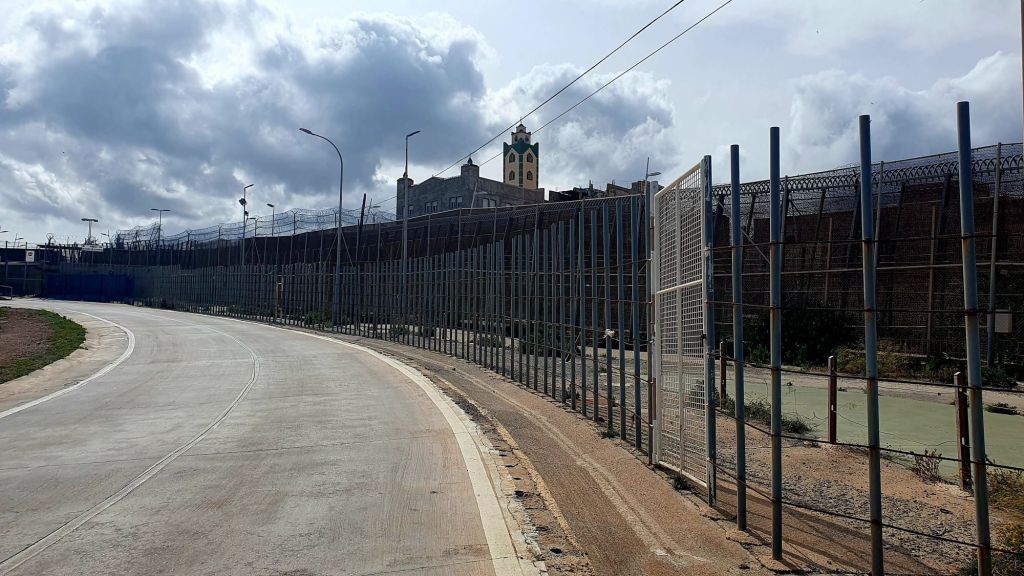


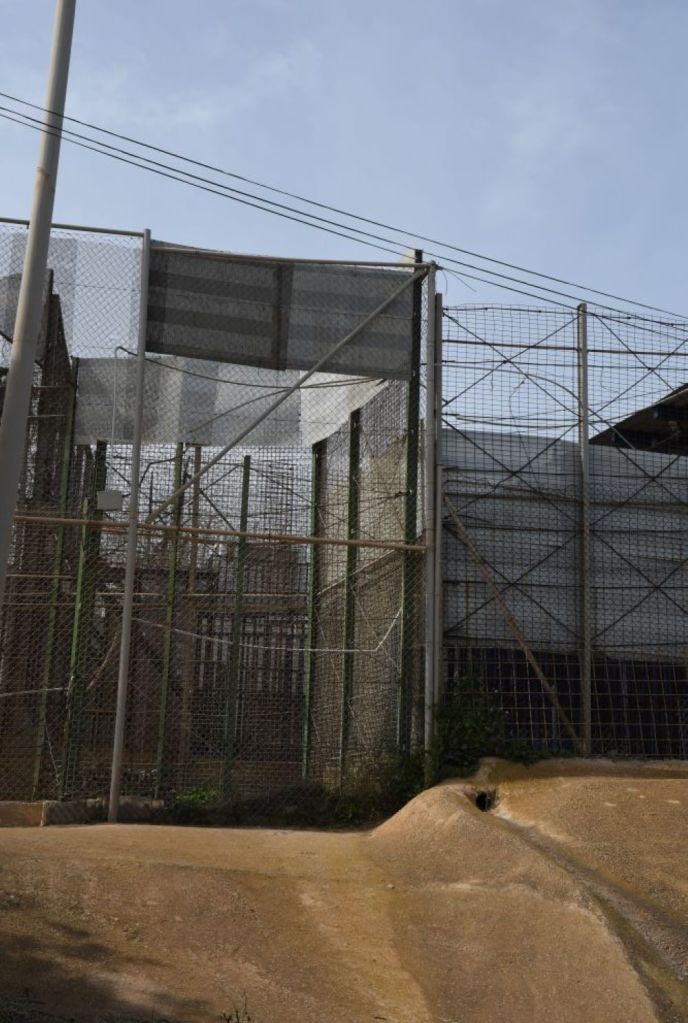

The border fence
The border fence is ever present and a quick look north or south shows the boundary and Morocco beyond

From the Moroccan side
We took the opportunity of visiting the 4 border crossings from the Moroccan side. We had fully researched the events of June 2022 by the time we approached the Moroccan side of the checkpoint. We were very discreet, however to no avail. An elderly man decided to inform the security services. Once again there was questioning, passport checks and requests to delete photographs. In Morocco, the officials tended to be young, educated, with a high standard of English, they never identified themselves or their agency. After 20 minutes we were once again free to go.


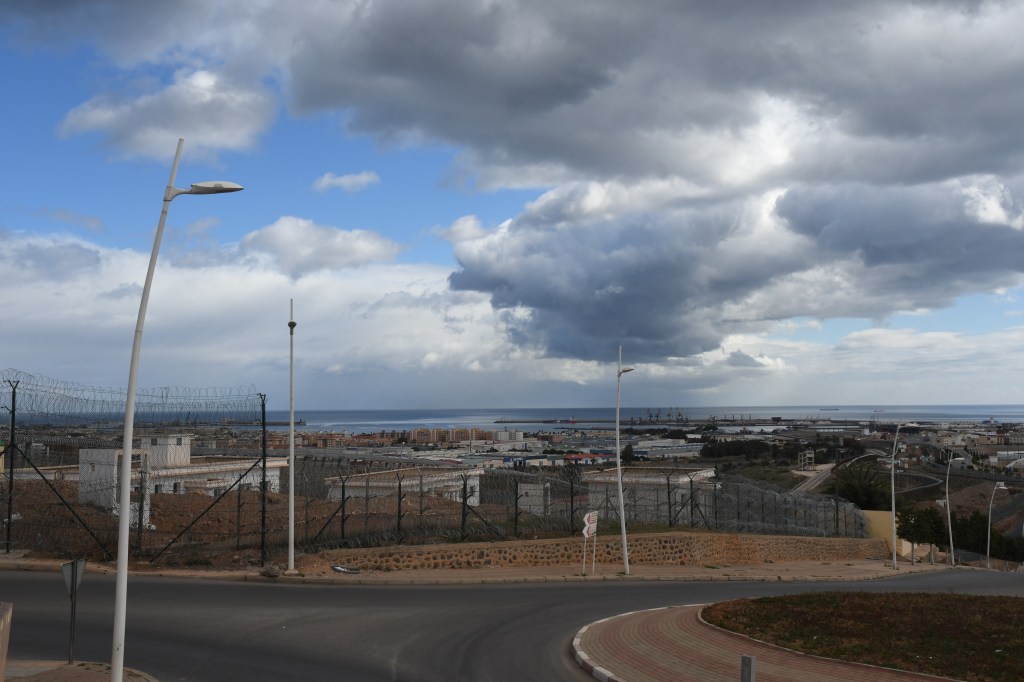
This was one of the hardest border posts to visit and record. I leave you to judge the outcome.
Barrio Chino – what happened in June 2022?
The sensitivity of locals and law enforcement officials and their nervousness regarding our presence at this particular border crossing becomes clear with a review of the events of 24 June 2022. My last visit to a similar border with similar fatalities was the Berlin Wall in 1986. The fact that this happened in 2022 makes it all the more shocking. On 24 June 2022, 23 migrants and asylum seekers were killed after a crowd crush at the Melilla border fence during a conflict with Moroccan and Spanish security forces, a further 77 migrants remained missing after the event.
There is broad agreement about the sequence of events, where up to 1700 sub Saharan migrants moved from their camps outside Nador towards the border crossing with Spain. Some scaled the fences whereas other forced open a gate. Many pushed into an enclosed area and were crushed in the panic. What is contested is the role of both the Moroccan and Spanish officials on both sides of the border. Official reviews absolve law enforcement agencies of any wrongdoing citing the fault of the tragedy being the migrants themselves. Independent accounts (referenced below) refer to excessive force, push back techniques used by Spanish officials to remove 470 migrants from Spain, Moroccan personnel entering Spain to remove migrants, the lack of medical care for those injured. Migrants who successfully entered Spain were denied the opportunity to request asylum.
What happened on that day was a tragedy. The official position is that no wrongdoing occurred. Questions however remain.
Other Border Crossings between Melilla and Morocco
Please click on the images below for maps, photos and detailed reports of the other 3 border crossings



Date of Visits: 5 and 8 March 2024
References
- Documentary | Reconstructing the truth about the migrant deaths on the border of Morocco and Spain’s Melilla. El Pais (November 2022) Details and video here
- The Melilla massacre: how a Spanish enclave in Africa became a deadly flashpoint. The Guardian (London August 2023) Article here
- Between the silence and the lies. (Amnesty International December 2022) Article here
- Reconstructing the Melilla Massacre. Lighthouse Reports (November 2022) Article here.
 Barry's Borderpoints